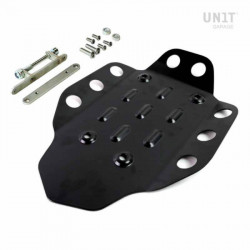
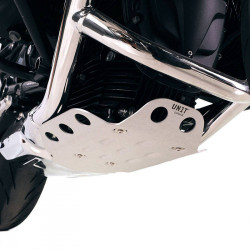
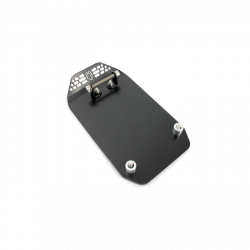
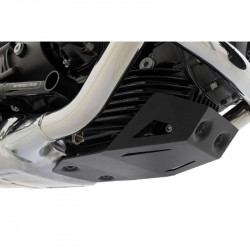
Engine Guard
Why a Tip-Over Costs More Than the Guard Itself
The BMW boxer engine is legendary, but its layout has a hard truth: the cylinder heads sit outboard of the frame. In a stationary drop or a low-speed slide, the magnesium or aluminium valve cover takes the full brunt. A cracked cover, a distorted cam carrier, or a snapped valve — none of that is cheap. An engine guard for the R12 and R NineT range works like a sacrificial first layer. It absorbs the energy and keeps expensive internals off the tarmac. The choice is simple: a few hundred euros for a bolt-on guard, or a four-figure repair bill without one.
Two Paths to the Same Goal: Crash Bars vs. Cylinder Head Covers
Not every rider needs the same coverage. You have two distinct approaches:
- Crash bars (engine guard bars) — A wraparound tubular structure that mounts to the frame and extends laterally past the cylinder heads. They protect the engine during a slide and often double as a mounting point for auxiliary lights or highway pegs. The Unit Garage crash-bar in red and the Heavy Duty version both offer this full-frame protection, with 27 mm steel tubing that deforms progressively in a serious impact.
- Cylinder head covers — Direct bolt-on shields that replace or overlay the valve cover. They hug the engine tightly and add minimal width. The Unit Garage silver cylinder head cover is a popular alternative for riders who prefer a lower-profile look and rarely venture off sealed roads.
Some builds run both — a slim head cover under a removable crash bar for maximum security at track days or off-road.
What Unit Garage Brings to the Table
The shop’s protection range is anchored by Unit Garage, an Italian manufacturer known for R NineT-specific engineering. Their crash bars use an electrostatic powder-coat finish in either black or a deep red that echoes BMW’s own styling. The cylinder head cover is cast from aluminium and CNC-finished to mate perfectly with the R12’s mating surface, using the original bolt pattern. No shimming, no bending. Every guard comes with the required hardware and a clear torque spec, so you can bolt it on with basic tools in under an hour.
Compatibility Across the R12 Family
The current R12 platform — roadster, NineT, and GS — shares a common engine architecture, but frame dimensions and tank shapes vary. A crash bar marked for the R12 GS will fit the R12 and R12 NineT as well, because the engine-to-frame mounting points remain identical. However, hand guard clearance and bodywork clearance differ; that’s why Unit Garage offers separate hand guard extensions for the GS. If you run a GS, the hand guard kit pairs logically with engine protection. Check the product’s fitment notes, but the guard itself is cross-compatible across the three models.
Weight, Lean Angle, and Real-World Feel
Riders often worry about scraping hardware mid-corner. A well-designed engine guard follows the OEM lean-angle envelope — most add less than 12 mm of width each side. The Unit Garage crash bar weighs roughly 2.8 kg, which is negligible next to the boxer’s 229 kg wet weight. You won’t feel it in the steering, and you won’t drag a peg before the guard touches down; the bank angle is preserved.
Every guard we send out leaves our warehouse within one business day, so your bike won’t sit unprotected for long. Whether you daily-commute on a R12 NineT or take an R12 GS onto gravel tracks, bolting on the right engine protection turns a stressful moment into a non-event.